


Address:South of 18th Floor, New Oriental International Technology Center, 567 Jiangling Road, Binjiang District, Hangzhou City
New product development
During the fermentation process for producing ethanol from raw materials such as cassava and corn, large amounts of carbon dioxide are generated. Theoretically, the fermentation of starchy or sugary raw materials to produce 1 ton of ethanol releases 0.956 tons of carbon dioxide gas. For large and medium-sized ethanol producers, the volume of CO₂ released is clearly substantial. Recovering and processing this CO₂ into high-purity liquid CO₂ enables the production of downstream products such as solid dry ice and chemical feedstocks. CO₂ is a critical raw material in various industrial sectors. Recovering CO₂ not only reduces environmental pollution and generates economic and social benefits but also mitigates atmospheric pollution and the greenhouse effect.
Carbon dioxide is a significant byproduct of ethanol fermentation plants, typically with a purity of around 97%–98%. However, after water washing and recovery of low-alcohol distillate, the purity of the CO₂ can reach approximately 99%. For example, in ethanol fermentation using cassava or starch, the resulting CO₂ gas contains trace impurities such as sulfur, alcohols, aldehydes, and water vapor.
Existing traditional methods for producing food-grade CO₂ from alcohol tail gas, both domestically and internationally, generally involve a series of processes including scrubbing, purification, drying, compression, liquefaction, and distillation to produce food-grade CO₂. In the original process, the scrubbing stage primarily involves using industrial water in a packed scrubbing tower to contact the feed gas in a countercurrent flow, dissolving and removing heavier components such as alcohols, organic acids, and esters into the water, while lighter components are removed via two-column distillation. However, this method of impurity removal has the following drawbacks: (1) It requires a large amount of industrial water, wasting water resources and failing to meet environmental standards; (2) It generates a large volume of wastewater, limiting the selection of plant sites and hindering compliance with environmental requirements; (3) It increases the need for power-consuming equipment such as circulating water pumps, thereby raising water-related energy consumption; (4) Based on market analysis over the past decade, the process utilizing a cold box and dual-column distillation—where the pre-distillation column removes heavy components and the main distillation column removes light components—has been employed. However, analysis of the actual operation and product quality of more than ten domestic ethanol gas recovery production units shows that the CO₂ product rarely meets food-grade quality requirements and exhibits a severe odor due to sulfur content. These processes do not include desulfurization units, yet the actual feed gas contains complex sulfur compounds. Many companies continue to seek optimizations in adsorption purification and desulfurization units to meet food-grade quality requirements; some companies’ product quality is even inferior to industrial-grade standards (primarily due to the absence of desulfurization). Therefore, the conventional method of using water washing to remove impurities from alcohol gas is not thorough and is also insufficiently clean, environmentally friendly, or energy-efficient.
In response to the issue of substandard quality in the recovery of food-grade CO₂ from alcohol fermentation tail gas, technical experts at the R&D Center of Hangzhou Kuai Kai High-Efficiency Energy-Saving Technology Co., Ltd., drawing on their professional experience in CO₂ production and extensive on-site analysis and research, concluded that traditional process routes are unsuitable for CO₂ recovery in alcohol plants. These conventional methods suffer from high capital investment, operational complexity, and difficulties in meeting product quality standards. Consequently, the R&D Center of Hangzhou Kuai Kai High-Efficiency Energy-Saving Technology Co., Ltd. has developed a new process for producing high-purity, food-grade carbon dioxide from alcohol tail gas. The process flowchart is shown below. This new process offers significant advantages in terms of environmental protection, energy efficiency, and reduced capital investment.
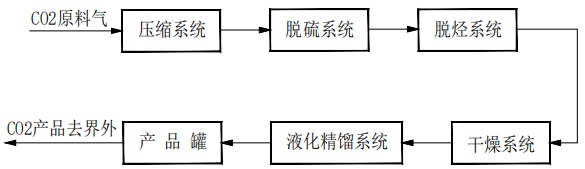
Figure 1: Flowchart of the Process for Producing Carbon Dioxide from Alcohol Exhaust Gas
The new process utilizes patented technology, proprietary equipment, and catalysts from Hangzhou Kuai Kai High-Efficiency Energy-Saving Technology Co., Ltd. It incorporates a new desulfurization unit and replaces the water washing and pre-distillation systems of the traditional process with a hydrocarbon removal system. The highly efficient, novel hydrocarbon removal process replaces the traditional water washing process; hydrocarbon removal involves the removal of combustible components such as alcohols, aldehydes, organic acids, and esters. This dehydrocarbonization is carried out via catalytic oxidation under the action of a catalyst, converting all flammable gases into CO₂ and H₂O. The resulting gas is then dried, liquefied, and distilled, with the final product stored. This process ensures consistent compliance with high-purity food-grade carbon dioxide quality standards. The main advantages of the new process are as follows:
(1) No wastewater is generated, making it clean and environmentally friendly;
(2) Heat generated during the dehydrocarbonization process can be recovered and reused;
(3) Water and energy savings reduce operating costs;
(4) Fewer pieces of equipment are required, saving on investment costs and floor space;
(5) The process features high technological sophistication; this new process, patented equipment, and proprietary catalyst are our company’s patented technologies and proprietary products.
(6) Each unit is skid-mounted, reducing installation costs;
(7) Skid-mounted units are easy to maintain, saving time and labor.
In summary, the new process for producing high-purity, food-grade carbon dioxide from ethanol off-gas—which incorporates an additional desulfurization unit, utilizes a new catalytic oxidation process for hydrocarbon removal, and features a highly efficient liquefaction and distillation unit—is currently the most cost-effective, space-efficient, and stable new technology available, requiring minimal equipment and investment while ensuring consistent product quality and smooth operation.
Contact Us
Address:South of 18th Floor, New Oriental International Technology Center, 567 Jiangling Road, Binjiang District, Hangzhou City

Phone:+86-571-87177512 87177550 87177513

Email:hangzhoukuaikai@vip.163.com

Fax:0571-87177570
Quick Navigation

Browse the mobile website